
How to Unlock a Car Boot Manually and Safely

A boot that will not open can turn a simple errand into a real problem, particularly when your shopping, work equipment, pram or spare key is inside. If you need to unlock car boot manually, resist the temptation to force the lock, bend the boot lid or prise trim panels apart. Modern vehicles often hide electrical wiring, latch cables, airbags and sensors behind those panels, so a quick DIY attempt can create an expensive repair.
The right next step depends on why the boot is stuck. A flat vehicle battery, faulty key fob, failed latch, deadlocking issue or lost key can all leave you without access, but each needs a different solution. Start with the safe checks below, then call a professional mobile auto locksmith if the boot remains shut.
When you need to unlock a car boot manually
A manual method is most relevant when the car will not respond to the remote, central locking has failed or the boot-release button does nothing. Some vehicles have an emergency internal release, while others have a mechanical key barrel concealed under a badge, handle cover or trim cap. Not every car has either feature, especially older models and some saloons.
Before trying anything, make sure you are somewhere safe. If the vehicle is parked on a live road, in a poorly lit area or with children or pets inside, call for immediate assistance rather than spending time diagnosing the fault. Never climb into the boot through folded rear seats if doing so could put you at risk or damage the interior.
Check the simple causes first
Try the normal key fob and boot button once more from close range. If the car is completely unresponsive, check whether the vehicle battery may be flat. Warning signs include dim interior lights, no dashboard display, slow central locking or no response from the horn.
If you have a spare key, test it. A working spare can show whether the problem is the main fob battery or a fault with the vehicle itself. Replacing a weak fob battery may restore remote functions, but it will not fix a damaged boot latch, a failed actuator or a key that has lost programming.
Also check that the car is fully unlocked. On some vehicles, the boot remains secured when the doors are open because the car is in valet mode, double-lock mode or a security setting that disables the external boot release.
Look for the manufacturer-approved emergency release
Many hatchbacks, estates and SUVs have an emergency boot-release handle or lever inside the luggage compartment. It is usually designed for escape from inside the vehicle, not routine access, but it may help where rear seats can be safely folded from the passenger compartment.
Check the vehicle handbook for the correct location and operation. Avoid guessing or pulling unidentified cables. A bright-coloured handle may be an emergency release, but wiring looms, seat mechanisms and trim fixings can look similar in low light.
If the rear seats do not fold from inside the cabin, do not force them. Certain vehicles need the boot open before the seat release can be reached. Forcing seat backs or trim may damage catches, clips and upholstery without getting the boot open.
Use the mechanical key only where intended
Some remote keys contain a small mechanical blade. This may open the driver’s door and, on certain models, the boot lock. Look in the handbook for the intended keyhole location before attempting it. A key barrel may be hidden beneath a removable cover, but using tools to remove exterior trim can scratch paintwork or break clips.
If the mechanical key turns but the boot stays closed, stop there. The issue may be a seized latch, a broken linkage or an electrical fault. Repeated force can snap the key blade in the lock, turning a straightforward attendance into a more involved repair.
Why forcing the boot is rarely worth it
A jammed boot is frustrating, but a damaged boot lid is worse. Modern tailgates and boot lids often contain reversing-camera wiring, number-plate lights, high-level brake lights, central-locking components and, on some vehicles, powered opening mechanisms. Levering around the latch can bend the panel or damage the striker alignment, leaving the boot difficult to close securely afterwards.
Drilling a lock is not a sensible home fix either. It can damage the lock housing and may not release an electronically controlled latch. It also creates a security problem until replacement parts are fitted.
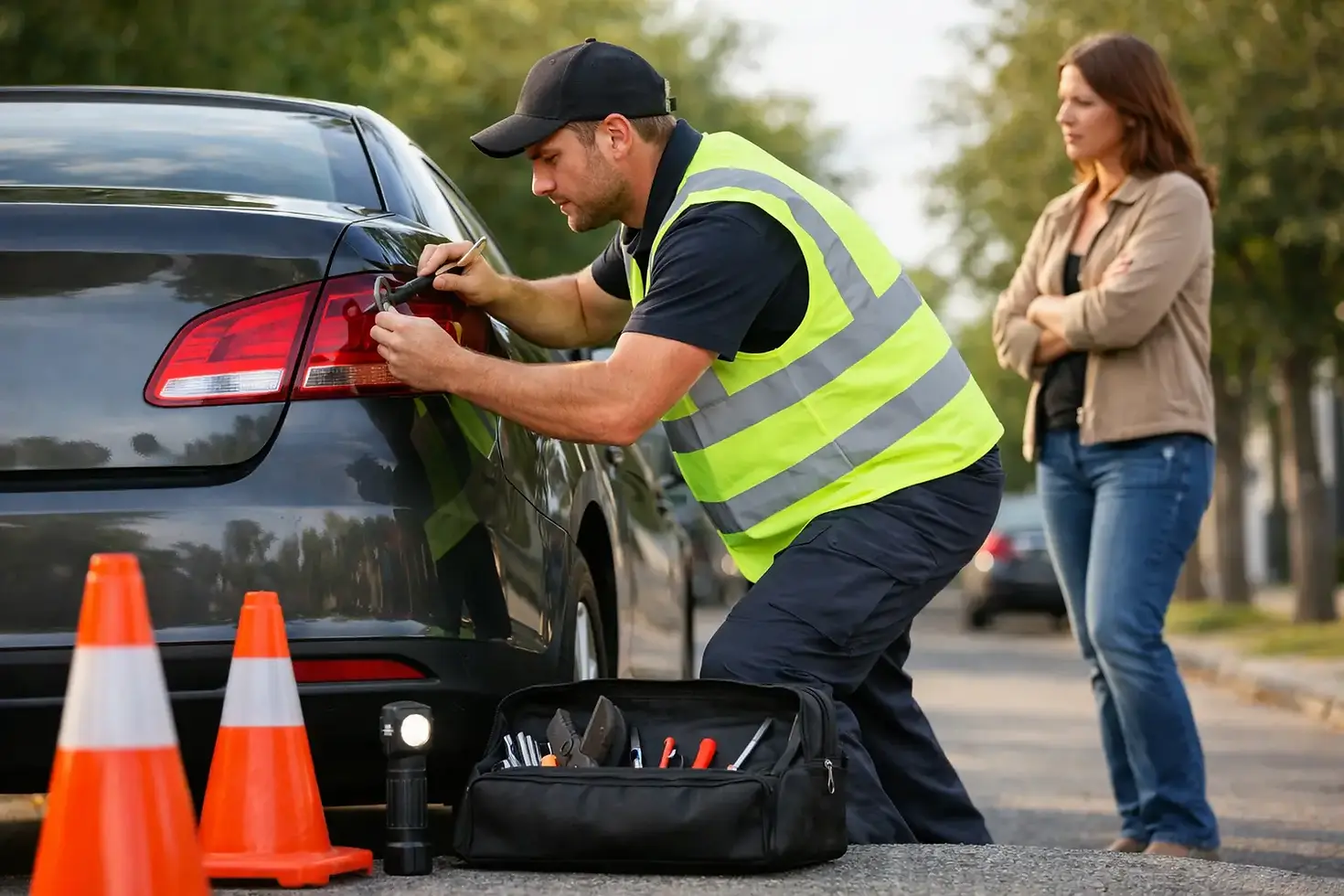
A professional auto locksmith will first identify the vehicle and likely fault, then use non-destructive entry methods where possible. This is particularly useful when the keys are locked in the boot, the remote has failed or the car has gone into a deadlocked state. The aim is to regain access without creating bodywork, trim or locking-system damage.
Common boot-access problems and the right response
A flat car battery is one of the most common causes. If the battery is in the boot, accessing it can be awkward when the boot release is electrical. Depending on the vehicle, there may be an approved jump-start point under the bonnet that allows central locking to operate again. Use the handbook to confirm this. Connecting power incorrectly can damage electrical systems.
A failed remote fob is different. If the car responds to the spare key, the original may need a new battery, repair or reprogramming. If neither key works, the fault could be with the vehicle battery, receiver, fuse, wiring or locking module.
When keys have been left in the boot, avoid breaking a window. Glass replacement, clean-up and weatherproofing can cost far more than professional entry, and broken glass creates an immediate safety risk. A mobile locksmith can assess the lockout and work towards gaining entry without unnecessary damage.
If you have lost every key, the job is more involved than gaining access alone. A replacement key must be cut and programmed to the vehicle’s immobiliser before the car can be driven. For most cars, this can be completed at your home, workplace or roadside location with the correct diagnostic and key-programming equipment.
What a mobile auto locksmith can do on site
For drivers across Wolverhampton, Birmingham, Walsall, Dudley and the wider West Midlands, a mobile service removes the need to arrange recovery simply because the boot or keys have failed. Ro Driveline can attend the vehicle, verify ownership, assess the lock and key system, and provide the appropriate solution on site.
The process starts with the vehicle registration and a clear description of what has happened. This helps identify the likely key type, locking system and equipment needed before attendance. You should have proof of ownership or authority to use the vehicle available, such as identification and vehicle documents where possible.
For a lockout, the focus is safe, non-destructive access. For a faulty or missing key, the solution may include cutting a replacement blade, programming a remote or smart key, and checking that the new key starts the vehicle and operates the central locking correctly. Typical programming can take around 30 to 60 minutes, though all-keys-lost jobs, unusual models and electrical faults can take longer.
Ask for an upfront quote based on the registration before work begins. A clear quote should explain whether the price covers entry only, a replacement key, programming, a remote fob or additional diagnostic work. This matters because a spare-key job is usually simpler than an all-keys-lost situation.
Preventing the next boot lockout
Once access has been restored, consider having a tested spare key made. Keep it somewhere separate from the main key, not inside the car and not in the boot. A spare can save considerable time when a fob fails, a key is lost or the main key is accidentally locked with your belongings.
Pay attention to early warning signs too. An intermittent boot release, a remote that only works at close range, a stiff mechanical key or central locking that behaves inconsistently should be checked before it becomes an emergency. Small faults are often easier to deal with when you are parked at home rather than stranded with a full boot outside a shop.
If your boot will not open and safe checks have not solved it, call for professional assistance rather than forcing the mechanism. The quickest route back to normal is usually the one that keeps the vehicle intact and gets you moving again.


Comments